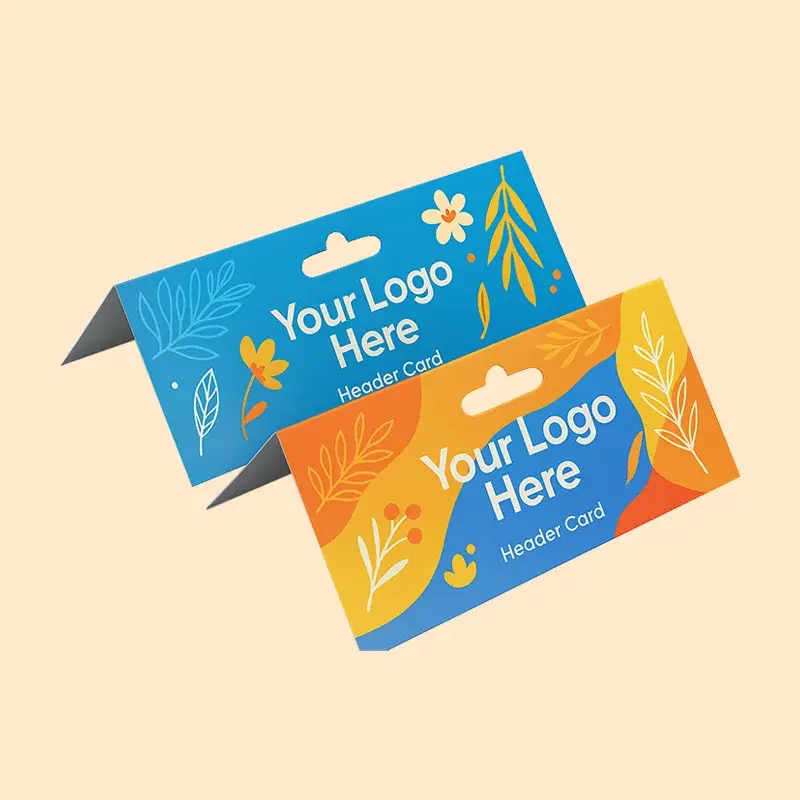
A clear bag full of product sells nothing by itself. It has no branding, no barcode and nowhere for a price, and most retailers will not put it on a shelf in that state. A folded card stapled over the top solves all of that in one cheap component. We produce a lot of header card work at ZEE Packaging and it is the fastest route from loose bagged stock to something retail ready.
It Turns A Bag Into A Product
A header card gives a plain bag everything it lacks.
- Branding sits at the top where shoppers look first
- A barcode makes the item scannable at a till
- Price and product information have somewhere to live
- A punched hole lets it hang on a peg
- The bag stays closed without needing a heat seal
- It costs a fraction of a printed pouch or a box
Most makers adding a header card do so because a stockist asked for something scannable and hangable.
Attachment Decides Durability
How the card meets the bag matters more than the print.
- Stapling is the most common method and the cheapest
- Two staples hold better than one and stop the card pivoting
- A folded card grips the bag from both sides
- Heat sealing gives a cleaner look on higher end products
- The fold line must be scored, or it cracks on folding
- Heavier contents need a thicker caliper to avoid sagging
- Folded over header card the standard format we run
- Single face version sealed rather than folded
- With a euro hole for peg display
- With a rounded hang hole a softer alternative
- Die cut shape following a logo or a motif
- With a tear off coupon a removable section for offers
Sizes We Print Regular
Every header card is built to your bag, though these run often:
- 3" x 2" folded, for a small bag
- 4" x 2.5" folded, the most common size
- 5" x 3" folded, for wider bags
- 6" x 3" folded, for larger products
- 2.5" x 1.5" folded, for compact items
- Custom widths matched to your bag exactly
Send us the bag width, since a card narrower than the bag looks wrong and a wider one catches on a peg.
Stock And Print
- 14pt to 24pt card stock depending on the weight below
- 18pt as a sensible everyday standard
- Kraft board for a natural or handmade position
- White SBS where you want vivid color
- Matte lamination, which resists scuffing on a busy display
- Uncoated stock where somebody writes a price by hand
Card stiffness matters here. A flimsy header card lets a filled bag sag and pull the staples through, which is the failure we get shown most.
Materials We Would Recommend
- Recycled card stock, widely available in these grades
- FSC certified paper, certificate available on request
- Soy based ink through the whole run
- Uncoated board, which recycles cleanly with no film
- Compostable bags alongside the printed card
- Right sizing so no board is wasted per unit
How An Order Works Here
- 100 unit minimum, so a small maker can order properly
- Free proof before anything prints
- Free artwork setup by our own designer
- Physical sample on request to check the fit on your bag
- Urgent turnaround at 5 to 8 business days
- Free shipping worldwide with nothing hidden
Frequently Asked Questions
Do you attach it to the bag?
We supply the printed card. Attachment usually happens at your end with a stapler, which is quick once you get going.
How many staples should we use?
Two, spaced apart. A single staple lets the card pivot and eventually tears through the bag top.
Which caliper for a heavy bag?
24pt. A filled bag pulls downward, and thin card sags or tears at the staple points.
Will the fold crack?
Not with proper scoring. Cracking happens when heavier stock is folded without a deep enough score line.
How much is a header card?
Rough estimate is $0.03 to $0.10 per unit plain, $0.05 to $0.15 with one color print and $0.09 to $0.24 for full color at moderate quantity. Volume moves it. Shipping is included in our price. This is estimate only, so ask our team for a exact quote.
Can we punch a euro hole?
Yes, reinforced. Peg display is usually the whole point, so we treat the hole as a priority.
Can prices be written on?
Only on uncoated stock. Laminated card resists pen ink, which matters at markets and craft fairs.