Custom Table Tents
A table tent sells to somebody who has already sat down and has nothing to do until their food arrives. That waiting period is the most receptive moment in the whole visit, and a card standing in front of them is the only thing competing for it. We produce a lot of table tent work at ZEE Packaging and the format keeps outperforming what it costs.
A Captive Moment
A table tent reaches people who are already waiting.
- Diners sit with nothing to read until food arrives
- It stands at eye level rather than lying flat
- Two or three faces mean the message works from any seat
- Dessert and drinks upsells land while somebody is still hungry
- Staff do not have to mention the offer themselves
- It sits there through every sitting, not just one
Most venues using a table tent see it lift the specific item it promotes.
It Has To Stand Up
Stability is what separates a working card from a fallen one.
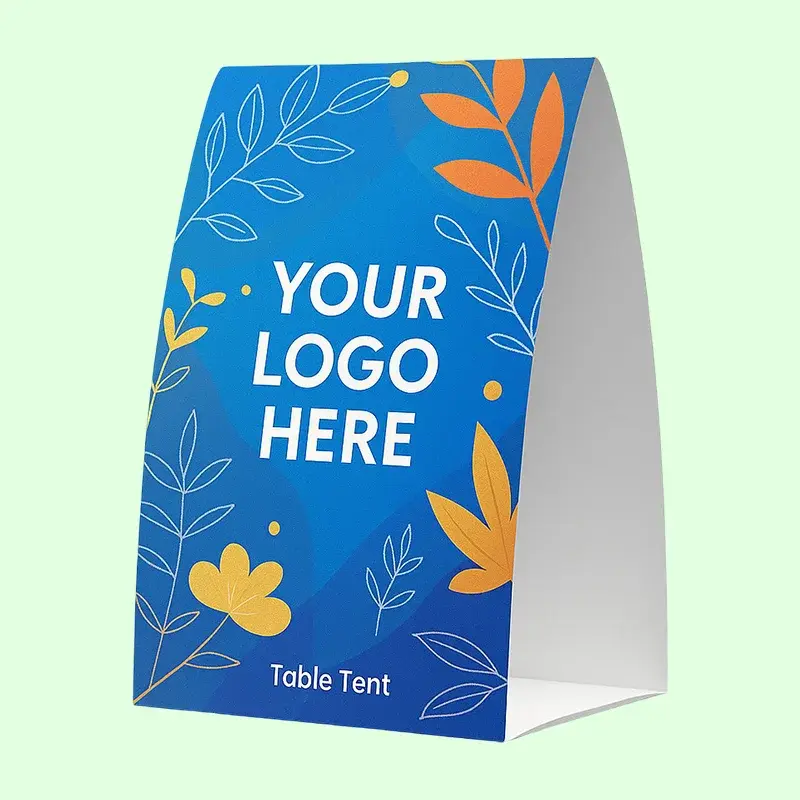
- A three sided triangular base is the most stable format
- The base must be wide enough to resist a knock
- Card too thin and the whole thing bows over
- A locking tab holds the shape rather than relying on glue
- Scored folds sit crisply instead of curling
- Laminated stock survives spills and wiping
- Three sided triangular the standard table tent we run
- Two sided A frame a slimmer footprint on a small table
- Four sided pillar visible from every angle
- Die cut shape a custom outline at the top
- With a base tab locking flat and staying put
- Double height version more space for a menu insert
Sizes We Print Regular
Every table tent is built to your setting, though these run often:
- 4" x 6" for a standard table
- 5" x 7" for a larger message
- 3" x 5" for a compact bar top
- 4" x 9" for a tall narrow format
- 6" x 8" for maximum visibility
- Custom sizes for unusual table layouts
Consider the table size honestly. An oversized table tent on a small bistro table gets moved aside by the diners themselves.
Stock And Print
- 14pt to 18pt card stock for most applications
- 16pt as a sensible everyday standard
- Gloss lamination, which wipes clean after spills
- Matte lamination for a softer restaurant look
- Uncoated stock where a rustic feel suits the venue
- Full color print across every visible face
Lamination matters more here than in most formats. A table tent sits in a food environment and gets touched, splashed and wiped constantly.
Materials We Would Recommend
- Recycled card stock, widely available in these grades
- FSC certified paper, certificate available on request
- Soy based ink through the whole run
- Aqueous coating instead of plastic lamination
- Uncoated stock, which recycles cleanly at end of use
- Right sizing so no board is wasted per unit
What Ordering Looks Like With Us
- 100 unit minimum, so a single venue can order properly
- Free proof before anything prints
- Free dieline drawn by our own designer
- Physical sample on request to test the stability
- Urgent turnaround at 5 to 8 business days
- Free shipping worldwide with nothing hidden
Frequently Asked Questions
What does a table tent cost?
Rough estimate is $0.15 to $0.45 per unit on 14pt, $0.25 to $0.60 laminated and $0.40 to $1.00 for larger formats at moderate quantity. Volume moves it. Shipping is included in our price. This is estimate only, so ask our team for a exact quote.
Will it fall over?
Not with a wide enough base and the right caliper. Thin card bowing is the usual reason one collapses.
Do they arrive assembled?
Flat, and they fold up in a couple of seconds. That keeps your storage minimal between promotions.
Should we laminate?
In a food setting, yes. Spills and wiping ruin an unlaminated card within days on a busy table.
Which caliper should we choose?
16pt for most tables. Larger formats need 18pt, since the taller the card the more it wants to bow.
How many faces should we print?
All of them. Diners sit around the table, so an unprinted face is wasted on somebody.
Can we change them seasonally?
Easily, and plenty of venues do. We hold your dieline so reprints skip setup entirely.