Custom Punch Partition
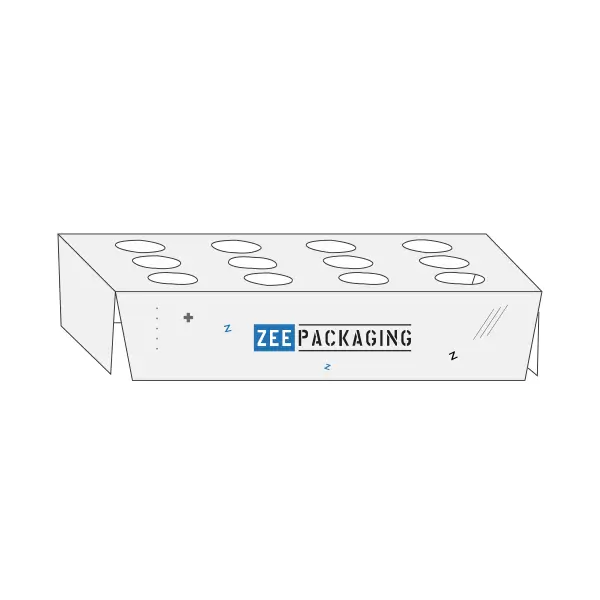
A punch partition is cut from a single sheet with the dividing walls punched and folded up out of the board itself. There are no separate strips to slot together and no assembly sequence to learn. It drops into a carton as one piece and the cells are already there. We produce a lot of punch partition work at ZEE Packaging and the single piece build is the main reason clients choose it.
One Piece, Cells Included
A punch partition comes ready formed rather than assembled.
- Walls are punched and folded from one sheet
- No separate strips to slot together
- It drops into the carton in a single motion
- Nothing gets miscounted or left out at the bench
- Assembly time drops considerably against a fence
- It recycles as one piece with the carton
Most operators choosing a punch partition want speed at the packing line rather than maximum protection.
Where It Beats A Fence Partition
Each format suits a different situation.
- A punch partition is faster to place, since it is one piece
- A fence partition gives stronger cell walls
- Punch suits lighter items and shallower cells
- Fence suits heavy glass and full height separation
- Punch uses less board for the same cell count
- We would advise honestly on which fits your product
- Standard grid punch partition the everyday build we run
- Four cell version for small multipacks
- Six cell format the most common configuration
- Twelve cell version for full cases
- Half height version separating the base only
- With a shaped cell matched to a product profile
Sizes We Print Regular
Every punch partition is built to your case, though these run often:
- 4 cell for a four item pack
- 6 cell for a standard six pack
- 9 cell for jars and squat containers
- 12 cell for a full case
- 24 cell for smaller items
- Custom grids to suit any case layout
Send us the case dimensions along with the product, since both determine the grid.
Board And Construction
- E flute corrugated for lighter items
- B flute where cells need more strength
- Chipboard for small light products
- Kraft corrugated, since partitions are rarely printed
- Half or full height depending on the product
- Precise punching so the walls fold up cleanly
Cell height is the practical limit here. Punched walls cannot be as tall as slotted strips, so for full height separation we would move you to a fence.
Materials Worth Choosing
- Recycled corrugated and chipboard, standard here
- FSC certified board, certificate available on request
- Board replacing plastic dividers and foam
- No adhesive used anywhere in the build
- Less board than a fence partition of the same cell count
- Right sizing so no material is wasted per set
How An Order Runs Here
- 100 unit minimum, so a small producer can order properly
- Free 3D mockup and flat proof before anything prints
- Free dieline drawn by our own designer
- Physical sample on request to test with real product
- Urgent turnaround at 5 to 8 business days
- Free shipping worldwide with nothing hidden
Frequently Asked Questions
How is it different to a fence partition?
A fence uses separate slotted strips. This is punched from one sheet, so it drops in as a single piece.
Which is stronger?
A fence, generally, since the strips are full height. Punch trades some strength for far quicker placement.
How tall can the cells be?
Shorter than a fence allows. For full height separation around glass, we would suggest a fence instead.
How much is a punch partition?
Rough estimate is $0.10 to $0.32 per set for a six cell version, $0.18 to $0.50 for twelve cell and $0.30 to $0.80 for larger grids at moderate quantity. Board grade moves it. Shipping is included in our price. This is estimate only, so ask our team for a exact quote.
Does it need assembly?
Barely. The walls fold up as it is placed, so it is essentially a drop in component.
Can it replace plastic dividers?
Easily, and most producers have already switched. Board recycles with the carton, unlike plastic.
Can cells be shaped?
Yes, cut to a product profile rather than square. It suits irregular items well.