Custom Fence Partitions
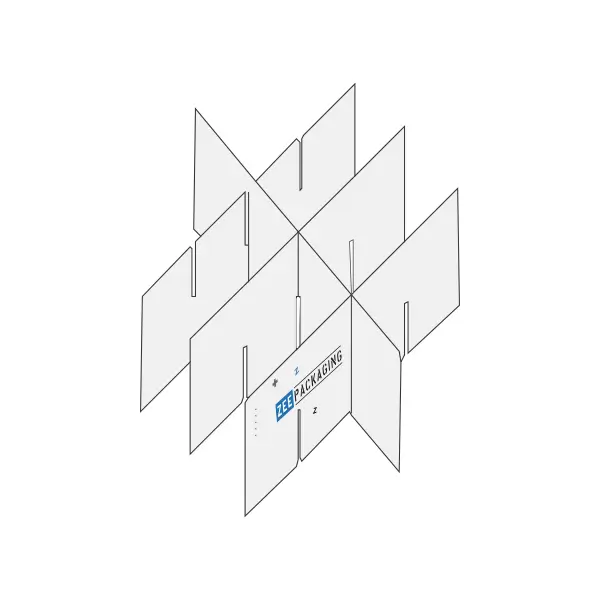
A fence partition is a set of interlocking board strips that slot together into a grid, creating a cell for each item in a case. Bottles, jars and glassware all travel far better when nothing can touch anything else. It is one of the oldest solutions in packaging and still the most effective. We produce a lot of fence partition work at ZEE Packaging and glass is where it earns its keep.
A fence partition keeps every item separated.
- Slotted strips interlock into a grid of cells
- Each item sits in its own compartment
- Glass never touches glass during transit
- Movement is contained rather than eliminated
- It absorbs some impact through the board itself
- Assembly is quick once the strips are cut correctly
Most breweries and distilleries using a fence partition do so after losing product to bottles knocking together.
Cell Size Is Everything
Too loose or too tight and the whole thing underperforms.
- A loose cell lets the item rattle and chip
- A tight cell makes loading slow and awkward
- Cell height should reach the shoulder of a bottle
- Slot depth must be half the strip height to interlock
- Board caliper affects how snug each cell sits
- Send us the actual product rather than dimensions
- Standard grid partition the everyday fence partition we run
- Two by two format for four bottle cases
- Two by three for six packs
- Three by four for twelve bottle cases
- Full height version reaching the top of the case
- Half height version separating the base only
Sizes We Print Regular
Every fence partition is built to your case, though these run often:
- 4 cell for a four bottle case
- 6 cell for a standard six pack
- 12 cell for a full case of bottles
- 9 cell for jars and squat containers
- 24 cell for smaller items
- Custom grids to suit any case layout
Send us the case dimensions along with the product, since both determine how the grid divides.
Board And Construction
- B flute corrugated for standard bottle partitions
- C flute where more cushioning is needed
- Chipboard for lighter items and smaller cells
- Kraft corrugated, since partitions are rarely printed
- Full height for maximum protection
- Slot depth cut precisely for a firm interlock
Board choice matters more than people expect. Too light and the strips flex, which lets the whole grid distort under load.
Materials Worth Choosing
- Recycled corrugated and chipboard, standard here
- FSC certified board, certificate available on request
- Board replacing plastic dividers and foam entirely
- No adhesive used, since the strips interlock
- Reusable across several transit cycles
- Right sizing so no board is wasted per set
Partitions are one of the easiest plastic swaps in packaging. Board performs just as well and recycles with the case around it.
How An Order Runs With Us
- 100 unit minimum, so a small producer can order properly
- Free 3D mockup and flat proof before anything prints
- Free dieline drawn by our own designer
- Physical sample on request to test with real product
- Urgent turnaround at 5 to 8 business days
- Free shipping worldwide with nothing hidden
Frequently Asked Questions
How high should the cells be?
Up to the bottle shoulder at minimum. Full height gives the best protection where the case allows it.
Do they arrive assembled?
Flat as separate strips. They slot together in a few seconds once staff have done a couple.
Will bottles still move?
Slightly within the cell, which is fine. What matters is that they cannot contact each other.
How much does a dividing fence cost?
Rough estimate is $0.15 to $0.45 per set for a six cell partition, $0.25 to $0.70 for twelve cell and $0.40 to $1.00 for larger grids at moderate quantity. Board grade moves it. Shipping is included in our price. This is estimate only, so ask our team for a exact quote.
Can it replace plastic dividers?
Easily, and most producers have already switched. Board recycles with the case, unlike plastic.
Which flute should we use?
B flute for most bottle applications. C flute where you want more cushioning between cells.
Can they be printed?
They can, though almost nobody does. Partitions sit inside a case and are rarely seen.