Custom Foam Inserts
Board alone cannot protect some products. Instruments, optics and electronics need cushioning rather than restraint, and foam inserts absorb shock where a die cut cradle cannot. We produce a lot of foam inserts at ZEE Packaging and high value items are where they belong.
Cushioning, Not Just Holding
Foam inserts absorb energy rather than only blocking movement.
- Foam inserts compress and dissipate impact force
- A board cradle holds the item but transmits shock
- Delicate internals survive drops that would fail
- Foam inserts hold a precise shape around an outline
- Surfaces stay unmarked against a soft face
- The product sits exactly where it was placed
Most clients specify foam inserts after board kept failing a drop test.
Which Foam For Which Job
The density and type both matter.
- PE, closed cell and resilient, for general use
- PU, softer and open cell, for lighter items
- EVA foam inserts for a premium finish and firm support
- High density for heavy or precision equipment
- Low density for light goods on a budget
- Anti static grades for electronics
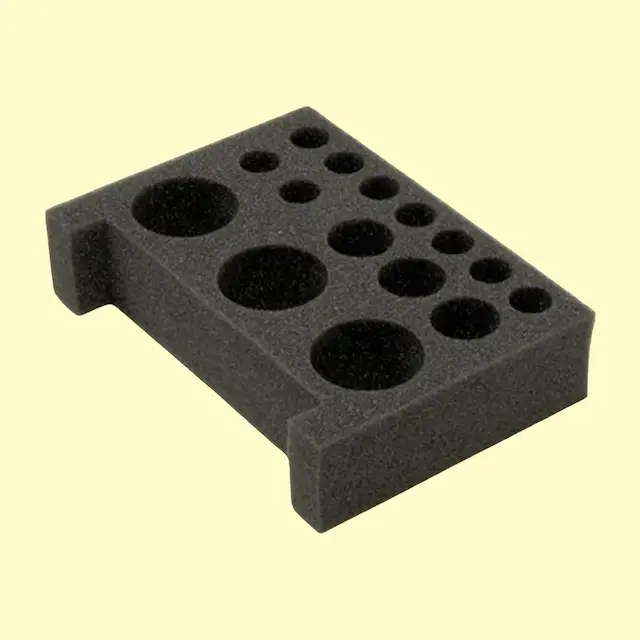
- Die cut foam inserts cut to your product outline
- Routed foam inserts CNC cut for complex shapes
- Layered inserts a base and a lid layer
- Convoluted foam the egg crate cushioning profile
- Anti static foam inserts for sensitive electronics
- Foam in a rigid box for gifting and presentation
Sizes We Print Regular
Every insert is cut to your product, though these run often:
- 6" x 4" x 1" for a small item
- 8" x 6" x 2" for a standard product
- 10" x 8" x 2" for a curated set
- 12" x 9" x 3" for larger equipment
- 4" x 4" x 1" for a compact size
- Custom shapes cut to any outline
Send us the actual product. Foam inserts are cut around a profile, and a drawing rarely captures how something sits.
Material And Finish
- PE, PU and EVA depending on the application
- Density chosen against the product weight
- Black, charcoal or white as standard
- Flocked or velvet finish on premium foam inserts
- Anti static grades where electronics are involved
- Cut tolerance tight enough to stop shifting
Density is what clients get wrong most. Soft foam inserts bottom out on impact, firm ones transmit shock straight through.
Being Honest About The Material
- Foam inserts are plastic, and we would not pretend otherwise
- Recycled content is available on some grades
- Molded pulp is greener where it works
- Cardboard suits anything not needing cushioning
- We steer you off foam inserts where board works
- Right sizing so less material is used
Plenty of products need no foam at all. If a board cradle passes your drop test, we would rather say so.
How An Order Runs With Us
- 100 unit minimum, so a small brand can order
- Free 3D mockup and proof before anything is cut
- Free design work by our team
- Physical sample on request, drop tested
- Urgent turnaround at 5 to 8 business days
- Free worldwide shipping, nothing hidden
Frequently Asked Questions
Do we actually need foam inserts?
Only if board fails your drop test. We would rather specify cardboard where it works.
Which density should foam inserts be?
It follows from product weight. We sample before committing rather than guessing.
How much do foam inserts run?
Rough estimate is $0.45 to $1.20 for a simple die cut, $1.10 to $2.80 for routed shapes and $2.20 to $5.00 for layered sets at moderate volume. Shipping is included. This is estimate only, so ask us for a exact quote.
Can foam inserts be recycled?
Some grades, though not curbside. That is the honest weak point of the material.
Do you offer anti static?
We do, for electronics and circuit boards. Standard foam carries a charge that damages parts.
Die cut or routed foam inserts?
Die cut for simpler outlines and volume. Routed for complex or multi level cavities.
Can foam inserts look premium?
Yes, with a flocked or velvet finish. In a rigid box they read very high end.