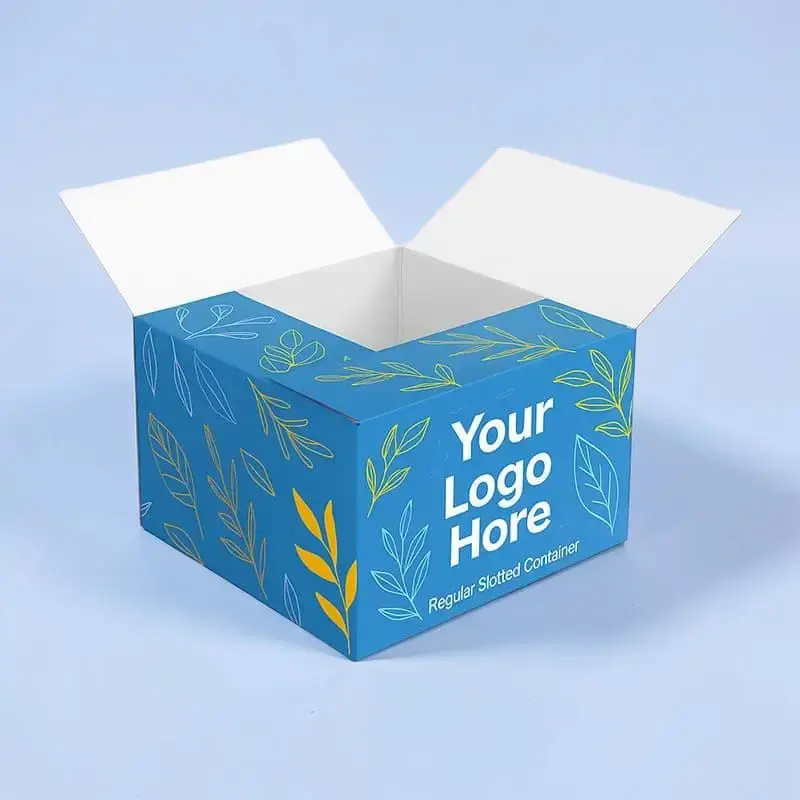
Custom Regular Slotted Container
This is the box most people picture when they think of a cardboard box, and there is a good reason it became the default. All the flaps are the same length, the outer ones meet in the middle, and the whole thing cuts from a single sheet with almost no waste. Simple, cheap, and it works. We produce a lot of regular slotted container work at ZEE Packaging and it remains the format we ship most.
Efficient By Design
A regular slotted container wastes almost nothing in production.
- Every flap is the same length, which simplifies the cut
- The dieline nests tightly, so more boxes come off each sheet
- Minimal board trim compared to more complex structures
- No glue needed, since the flaps meet and get taped
- Ships completely flat and folds in seconds
- Recycles as one clean piece with nothing added
Most operations use a regular slotted container as their default simply because nothing else matches it on cost per box.
Where It Falls Short
Being honest about the limits helps you choose properly.
- The outer flaps meet in the middle, leaving a seam
- That seam is exactly where impact tends to land
- Only single thickness across the top and bottom
- A full overlap doubles that if you need more protection
- It relies on tape, since nothing locks mechanically
- Heavy contents can push the flaps apart at the seam
- Standard specification the everyday regular slotted container
- Double wall version for heavy or palletized freight
- Water resistant coated damp warehouse or cold storage
- With a die cut insert protecting fragile contents
- Printed exterior branded shipping cartons
- Half slotted variant open top for tray applications
Sizes We Print Regular
Every regular slotted container is built to your product, though these run often:
- 8" x 6" x 4" for a standard order
- 12" x 9" x 6" for a mid size shipment
- 16" x 12" x 10" for larger goods
- 18" x 14" x 12" for bulk items
- 6" x 4" x 4" for small parcels
- 24" x 18" x 12" for oversized products
Send us the filled weight and the journey, since both drive the specification far more than dimensions alone.
Board And Print
- E flute for light contents and retail quality print
- B flute as the general shipping standard
- C flute where cushioning matters more than print
- Double wall for heavy freight and high stacking
- Kraft corrugated for plain economical shipping
- Flexo printing for one or two colors on the exterior
Stacking strength depends on the walls rather than the flaps. If your cartons go on a pallet, edge crush is the specification to focus on.
Materials That Reduce Impact
- Recycled corrugated, standard across nearly all grades
- FSC certified board, certificate available on request
- Soy based ink where the exterior is printed
- Gummed paper tape rather than plastic
- Reusable for return shipments where the structure allows
- Right sizing so you are not shipping air
How We Handle Your Order
- 100 unit minimum, so a small operation can order properly
- Free 3D mockup and flat proof before anything prints
- Free dieline drawn by our own designer
- Physical sample on request to test under real load
- Urgent turnaround at 5 to 8 business days
- Free shipping worldwide with nothing hidden
Frequently Asked Questions
How much is a regular slotted container?
Rough estimate is $0.35 to $0.90 per unit in E or B flute, $0.70 to $1.80 in C flute and $1.20 to $3.00 in double wall at moderate quantity. Size moves it. Shipping is included in our price. This is estimate only, so ask our team for a exact quote.
Why is it the most common format?
Because it uses the least board for the size and cuts with almost no waste. That efficiency is hard to beat on cost.
Is a full overlap better?
For impact resistance, yes, since the faces carry double board. It costs a little more, so it depends on your route.
Which flute should we pick?
B flute for general shipping, E for light retail, double wall for heavy freight. Tell us the weight and we will advise.
Does it need tape?
Yes, since nothing locks mechanically. Gummed paper tape bonds to the board and holds better than plastic does.
Can it be printed?
Flexo for one or two colors, litho lamination where retail quality print matters. Most shipping cartons use flexo.
Is it reusable?
Reasonably, though the flaps weaken with repeated taping. A full overlap survives reuse considerably better.