

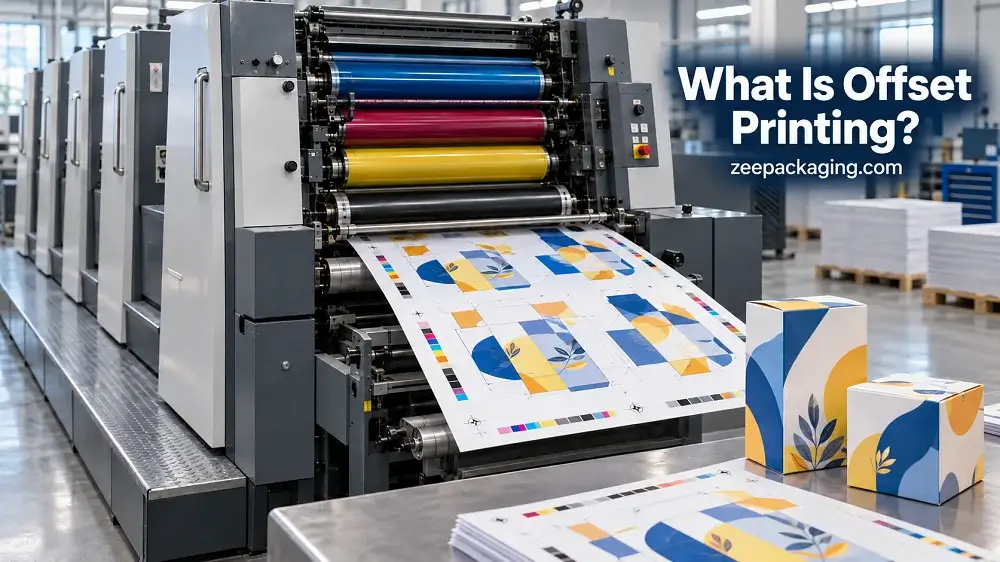
Offset Printing Explained: How Your Packaging Actually Gets Printed
Most people order boxes without ever thinking about what happens on the press floor. That is fine, you dont need to know. But if you understand a little bit about offset printing, your artwork comes out better, your costs make more sense and your conversation with us at ZEE Packaging gets a lot easier.
So let us break it down in plain language.
What Is Offset Printing Anyway
Offset printing, sometimes called offset lithography, is a method where the ink never goes directly from plate to paper. Instead it transfers from a printing plate onto a rubber blanket cylinder, and then that blanket rolls the image onto your sheet. That extra step is why they call it "offset" because the image is offset one time before it lands.
The whole thing works on a simple idea. Oil and water dont mix. The aluminum plate has image areas that attract ink and non image areas that attract water, also called the fountain solution. Ink sticks where it should, water keeps the rest clean.
Why Offset Printing Still Rules Packaging
Digital presses are everywhere now, so why does offset printing still hold the biggest share of carton production? Few honest reasons:
- Cost at volume setup cost is high but the unit cost drops fast after few thousand sheets
- Color accuracy Pantone spot color matching is much more reliable on offset printing
- Sheet size big format presses handle large sheets so you get more boxes per pass
- Substrate range offset printing runs on SBS, kraft, textured and metallized board
- Ink options soy based, oil based and water based inks all work
At ZEE Packaging we run offset printing for most of our folding carton and rigid box orders, and switch to digital only when the quantity is small.
The Parts of an Offset Press
If you ever walk through a print floor, here is what you are looking at:
- Plate cylinder carrying the aluminum plate
- Blanket cylinder with the rubber blanket that picks up the image
- Impression cylinder that presses the sheet against the blanket
- Ink train and dampening system feeding ink and fountain solution
- Feeder and delivery moving sheets in and stacking them out
Sheetfed offset printing is what most packaging houses use. Web offset runs on a continuous roll instead and is more for newspapers and magazines.
CMYK, Pantone and Why Color Shifts Happen
Standard offset printing uses four process colors, cyan, magenta, yellow and black. Together they build almost any shade through halftone dots, tiny dot patterns that your eyes blend into solid colors. Screen ruling, usually 150 to 200 LPI on cartons, controls how fine those dots are.
But process colors have limits. Some brand colors, especially bright oranges and deep blues, simply cannot be built from CMYK. That is when we add a Pantone spot ink as fifth or sixth unit. Many offset printing presses run six or more color stations exactly for this reason.
Other things that move colors around:
- Dot gain, where ink spreads slightly on absorbent stock
- Paper whiteness and coating
- Ink density settings on press
- Registration, meaning how well each color lines up
Good offset printing is really just controlling all these variables at the same time.
Prepress, Where Most Problems Get Caught
Before offset printing even starts, your file goes through prepress. This is where we check bleed, trapping, overprint settings, resolution and color mode. Computer to plate technology, or CTP, images your file straight onto the plate with a laser, no film needed like the old days.
A press proof or digital proof comes next so you see color before the run. Then makeready happens, which is the operator adjusting ink keys and registration until the sheet is right. Makeready wastes some sheets, and that is part of why offset printing needs a decent minimum quantity.
Offset Printing Versus Digital
Quick comparison:
- Short runs under 500 digital usually wins on price
- Medium to long runs offset printing wins, and the gap widens with volume
- Variable data digital only
- Spot colors and metallic inks offset printing is stronger
- Large sheets and heavy board offset printing handles them better
Neither one is "better". They just solve different problems, and at ZEE Packaging we pick whichever one fits your quantity and finish.
After the Press
Printed sheets dont go straight to boxes. They still need:
- Coating or lamination, matte, gloss or soft touch
- Foil stamping, embossing, spot UV if you order them
- Die cutting on a cutting die
- Stripping, folding and gluing
So offset printing is really just one step in a longer chain, though it is the step that decides how your colors look.
Quick Tips Before You Send Artwork
- Build your file in CMYK, not RGB
- Give Pantone codes if you have exact brand colors
- Keep resolution at 300 DPI
- Outline your fonts
- Add 1/8 inch bleed
- Avoid tiny reverse text under 7pt, offset printing can fill it in
People Asked Questions
Why is offset printing cheaper in large quantities?
Because plate and makeready costs are fixed. Once you spread them over 20,000 sheets instead of 500, the per unit cost falls a lot.
What does dot gain mean?
It is when halftone dots print slightly bigger than intended because ink spreads into the stock. Uncoated and kraft boards show more dot gain than coated boards.
Can offset printing do metallic and white inks?
Metallic inks yes, they run as spot colors. Solid white is harder on offset and usually we suggest foil or a white flood coat depending on the board.
How many colors can one press run?
Common setups are four, five, six and eight color. More units mean you can run CMYK plus multiple Pantone colors in single pass.
Is offset printing environment friendly?
It can be. Soy and vegetable based inks, alcohol free fountain solution and recyclable board all help, and waste is lower per unit on long runs.